Liberty MSN Community Health: a site where the community is the client
Liberty's Community Health concentration puts 300 practicum hours into NURS 671, 672 and 673, and the work is population-level: community assessment, social determinants of health and program planning. You choose the site in your own community. Unlike the Educator and Administration tracks, this one can't do practicum in Washington state.
Plan your community practicum
Tell us your state and when you reach NURS 671. A placement advisor will reply about community and public health sites near you.
NURS 671, 672 and 673HLTH 501, 503 and 505 alongside nursing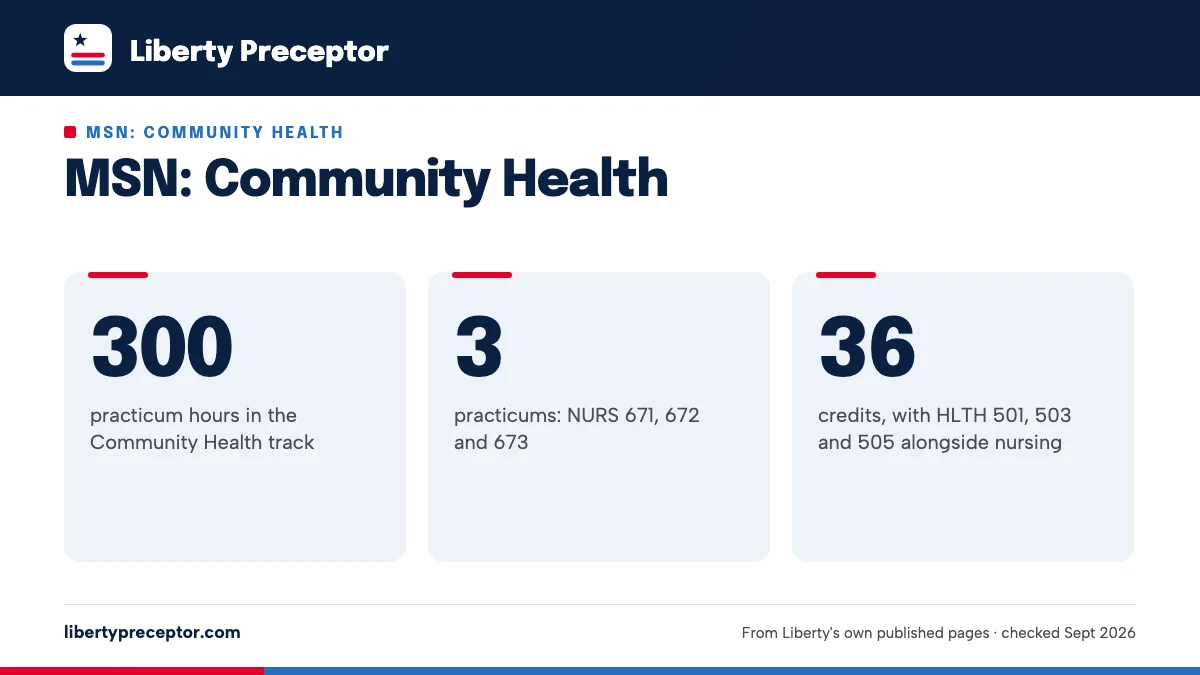
Community Health at Liberty, in brief
This 36-credit online MSN pairs the shared nursing core with public health coursework: HLTH 501, HLTH 503 and HLTH 505, plus NURS 523. Courses are 8 weeks with eight starts a year, including October 26, 2026, January 18, 2027 and February 15, 2027. Liberty lists an accelerated one-year option for this concentration alongside the standard six-semester plan.
Practicum paperwork begins in the first semester with the MSN Practicum Gate, NURS 527, which must be passed before any practicum course. A background check is required before practicum, and Liberty's MSN page says practicum hours can happen entirely within your own community. Every MSN practicum must also be completed inside the United States.
Liberty's MSN pages also carry a caution worth reading early: some states may hold clinical sites for their own in-state residential students, so check with your state's Board of Nursing or Department of Education first.
The three community practicums
The sequence moves from understanding a community to acting on what you find. The catalog lists 300 hours for the three courses together, without a per-course split.
| Course | Focus | Prerequisites |
|---|---|---|
NURS 671 Community Health Practicum I | The community as client: assessment, diagnosis and population data; clinical work in community settings begins | NURS 500 to 503, 521, 527 |
NURS 672 Community Health Practicum II | Social determinants of health | NURS 671 |
NURS 673 Community Health Practicum III | Community-based management and evidence-based program planning | NURS 672 |
The older 2022-23 handbook used 200 hours and the former numbers NURS 631, 632 and 633. If you see those in an old document, the catalog's current plan is the one to follow.
What kind of site and preceptor fit
The 2022-23 MSN handbook described the Community Health setting simply as a community or public health setting. Read that alongside the course focus: a site that lets you work with population data in NURS 671, look at social determinants in NURS 672, and help plan a program in NURS 673 will serve all three courses. A bedside unit focused on individual patients may not offer that kind of population-level work.
The current Community Health plan doesn't spell out the preceptor's degree the way the Educator, Administration and Health Policy plans do. The older handbook's MSN-wide rules are the best guide: an RN license in good standing plus an MSN or School of Nursing approval, with a doctorate, certification and two years' experience counting in a candidate's favor. Ask your course faculty which credential they expect before you invite anyone.
Under that handbook, you'd work with one approved preceptor per course, spend most of your time with them, and have them complete your evaluation. Our outreach guide helps with the first conversation.
Arranging the placement
Liberty's MSN catalog puts site selection with you: you choose a facility and secure the preceptor site contract before the practicum starts. The older handbook asked students to confirm, before enrolling, that sites and qualified preceptors were available in their area, and noted the MSN program works with students to secure preceptors. It also invited students to check with the MSN practicum coordinator for sites already on Liberty's approved list.
If your community agency doesn't require a contract at all, the older handbook described an Attestation of Agreement letter in place of Liberty's Clinical Program Affiliation Agreement. The site contract page explains which one fits your site.
Before practicum, the MSN catalog also lists AHA CPR, immunizations, HIPAA and bloodborne pathogens training, a background check and a 10-panel drug screen. The clearance page covers timing and renewals.
Your employer, approvals and logs
If you work for a health system or agency with a community arm, it may be tempting to use it. The 2022-23 handbook allowed practicum at your own workplace only if the hours were unpaid, an affiliation agreement covered the site, the site met course requirements, and your placement sat outside the program, unit or department where you're employed. No newer public rule has replaced it; the employer site page has more.
The same handbook set out how MSN practicum gets approved. The practicum coordinator signs off on registration for your first practicum course, and the course professor then approves your goals and objectives before you begin. Once hours start, logs and evaluations go through InPlace, which Liberty adopted for MSN practicum in 2022, and hours only count within the course's term dates.
Washington, DC and the territories
Liberty's state pages say Community Health students are not approved for practicum in Washington, and add that the School of Nursing will support placement in an approved state instead. DC is excluded as well, and territory residents need a site in one of the 50 states.
Enrollment itself isn't closed anywhere, because this is a non-licensure program. The practical effect falls on your practicum plan: a site in an approved state, and an RN license valid there, either that state's own or a multistate license it accepts. The Washington page and the state restrictions page go into each case.
Washington is open to Liberty's Educator and Administration practicums but closed to Community Health. Don't assume a classmate's approved Washington site will work for you.
Why Community Health students choose us
A community practicum is usually more about finding the right kind of organization than finding a clinician with open clinic slots, and an agency's approval process can take longer than a clinic's. We search for community and public health settings near you that suit the three-course arc, prepare the preceptor and site details the Gate course collects, and help with the agreement or attestation.
We also stay on call if your preceptor leaves between NURS 672 and 673. Our search runs beside anything the MSN practicum office can suggest. Liberty signs off on the agency and the preceptor, and an agency that has its paperwork early is ready when that review comes. When you know your NURS 671 term, use the form below.
Questions Liberty students ask
I live in Washington. Can I still do Liberty's MSN in Community Health?
Enrollment isn't closed in any state, but Community Health practicum isn't approved in Washington. Liberty's page says the School of Nursing will support placement in an approved state, which means doing your hours elsewhere with an RN license valid in that state. If that isn't practical, compare the Nurse Educator and Administration tracks, which are approved in Washington.
Can a public health nurse without an MSN precept me?
Possibly, but only with approval. The 2022-23 handbook asked for an MSN or approval by the School of Nursing, with a doctorate and certification preferred. A highly experienced public health nurse with a BSN might be accepted under the approval route. Send their details to the practicum coordinator and wait for an answer before logging hours with them.
Do volunteer hours at a health fair count toward Community Health practicum?
Only if they are part of your approved practicum. The older handbook counted hours only within course dates and after you had met your preceptor, and Liberty's malpractice coverage applied only to Liberty-scheduled practicum, not to volunteering. Ask your course faculty before the event whether it can be logged, and plan to have your preceptor present.
Do I need a different community site for each practicum course?
Liberty doesn't say you must change sites. The older handbook described one approved preceptor per course, and the courses move from assessment to social determinants to program planning, so one organization with a broad role may be able to serve all three. Confirm with faculty before NURS 671 that your chosen site can support the later courses too.
Related pages
Last checked 2026-09-23
We check these pages against Liberty's own published sources. The practicum team and Liberty's current handbook have the final word.
More leads, sooner, for your practicum.
Tell us your Liberty program, your county and when your practicum starts. We look for a preceptor and site that fit Liberty's rules for your track, and help you get the Gate-course paperwork right.
- Matched to your track: FNP, PMHNP, DNP or MSN
- Paperwork ready for the Gate course and the site contract
- In person near you, or telehealth where your track allows it
Start your placement plan
A placement advisor replies with what a Liberty-ready preceptor and site look like for you.